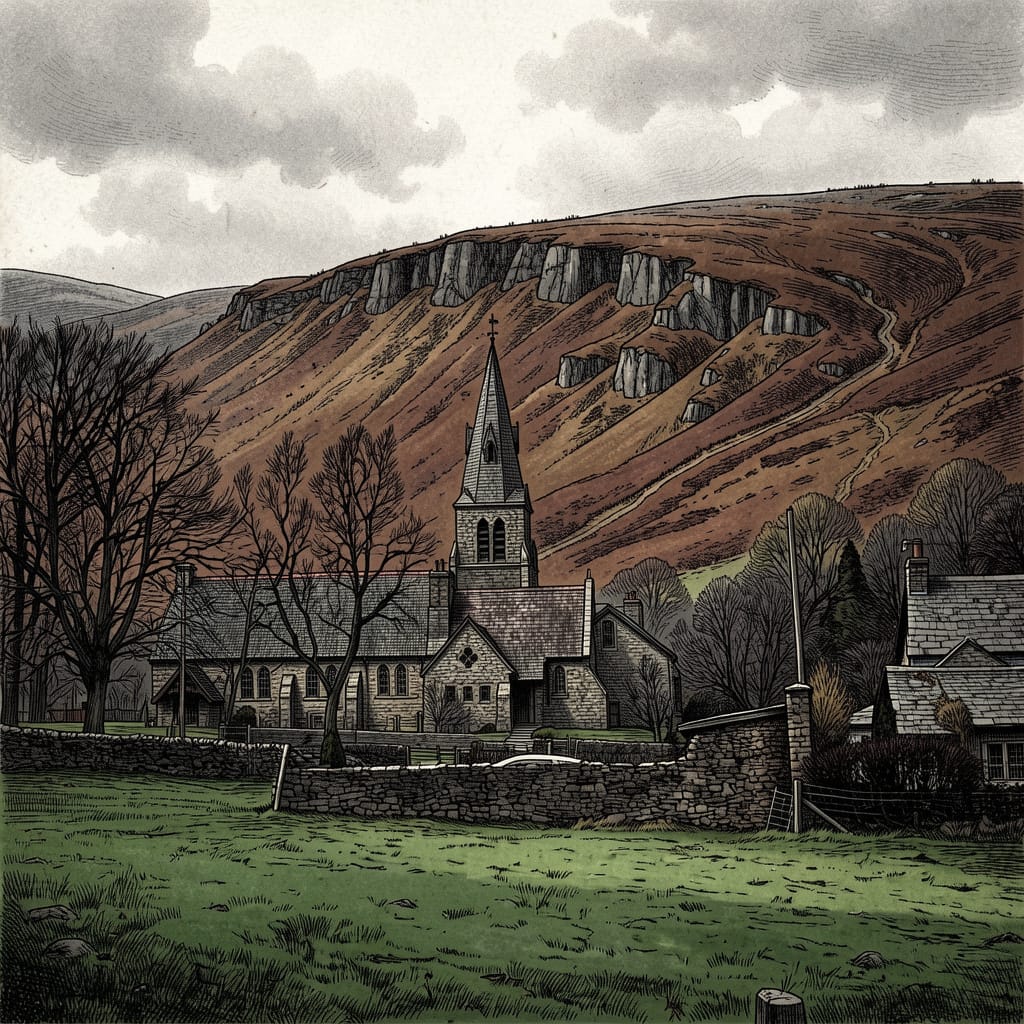
Edale

Edale — village in the Vale of Edale, beneath Kinder Scout

Location Profile
Type Village and civil parish
Borough High Peak
County Derbyshire, England
Region Peak District National Park
River River Noe
Parish Area 7,030 acres (2,840 ha)
Population 353 (2011 census)
Postcode S33
Recorded From Aidele, Domesday 1086
Notable Features Southern terminus of the Pennine Way; Hope Valley Line railway station; Edale Cross
First Appearance Cambion, Chapter Ten: Beautiful Lie

Edale

Village and civil parish in the Vale of Edale, at the southern foot of Kinder Scout.


Overview

Edale is a village and civil parish in the High Peak borough of Derbyshire, England, sitting in the Vale of Edale at the southern foot of Kinder Scout. The parish covers a substantial 7,030 acres — almost all of it open country — but the village itself is small, with a population recorded at 353 in the 2011 census, and almost the entirety of the parish lies above 200 metres in elevation. The settlement is best known internationally as the southern terminus of the Pennine Way, the 268-mile National Trail running from Edale north to Kirk Yetholm in the Scottish Borders.

Historically, Edale was the name not of a village but of the valley itself — the valley of the River Noe — with the present village name only first recorded as spelled in 1732. The parish lies entirely within the Peak District National Park, and is one of the principal walking centres of the central Peak.


Geography & Atmosphere

The Vale of Edale is an enclosed green valley of mixed pasture and rough hill-grazing running roughly west-east between two parallel high ridges. To the north, the Kinder Scout plateau (636 m / 2,087 ft, the highest point in Derbyshire) presents its long southern escarpment to the valley; to the south, the Great Ridge runs west to east through Rushup Edge, Mam Tor (517 m) and Lose Hill (476 m). The River Noe rises on the western slopes of Kinder, flows the length of the valley floor, and joins the River Derwent below Bamford. Win Hill rises east of the valley head; Brown Knoll, Horsehill Tor and Colborne enclose it to the west.

The valley is essentially treeless on its upper slopes, with the open moorland of the Dark Peak rising above the line of the final farms; the lower slopes carry hedge-divided fields and scattered farmsteads. The settlement is strung along the lane that runs from the railway station up to the head of the valley, with the older medieval settlement of the parish dispersed across five hamlets known as the booths — Upper Booth, Barber Booth, Grindsbrook Booth, Ollerbrook Booth and Nether Booth — each preserving the site of one of the medieval valley-side cattle farms from which the valley's settlement originated.

The Vale presents one of the more dramatic transitions in English upland landscape: a small green pastoral valley enclosed between two of the most heavily-walked moorland edges in the country. Edale railway station, on the trans-Pennine Hope Valley Line between Manchester Piccadilly and Sheffield, places the village within roughly an hour of either city by train — an unusual degree of public-transport accessibility for a settlement deep in a National Park.

History

Settlement of the Vale of Edale appears to date from at least the early medieval period, although the principal Iron Age and Romano-British activity of the central Peak is concentrated on the surrounding ridges — Mam Tor immediately south, Brough-on-Noe (the Roman fort of Navio) a few miles east — rather than on the valley floor. The valley itself was, after the Norman Conquest, part of the royal Forest of High Peak, a Crown hunting preserve administered with some rigour through the medieval period. Edale Cross, on the high moor at the western head of the valley, marked the junction of three of the Forest's administrative wards — Hopedale, Longdendale and Campana — from at least the medieval period and probably earlier.

The valley's medieval settlement pattern, established in the thirteenth century, was based on vaccaries (cattle farms, or ‘booths’) granted to local tenants along the valley sides. The five hamlets of Upper Booth, Barber Booth, Grindsbrook Booth, Ollerbrook Booth and Nether Booth descend directly from this settlement pattern; the name forms still in use today preserve the medieval grant-tenancies almost unchanged. The valley name is first recorded in Domesday Book (1086) as Aidele, with the sequence of recorded forms running through Heydale (1251), Eydale (1275), Eydal (1285) and Edall (1550) before reaching the modern spelling, first attested in 1732.

The Old Nag's Head, at the head of the village, was originally a smithy of 1577 and is among the older surviving buildings of the parish; it has functioned as a pub since the eighteenth century, and as the official southern start-point of the Pennine Way since 1965. The opening of the Hope Valley Line between Sheffield and Manchester in 1894, with a station at Edale, transformed the valley's accessibility; the railway has since been the principal route by which the urban populations of Manchester and Sheffield reach the central Peak.

The valley has been at the centre of the modern open-access movement. The 1932 Mass Trespass on Kinder Scout, planned and led by the British Workers' Sports Federation under Benny Rothman, was a two-pronged action: the main contingent of approximately four hundred trespassers ascended the plateau from Hayfield to the west, while a smaller Sheffield contingent climbed up out of Edale via Jacob's Ladder and Edale Head to meet them on the top. The two groups met briefly on the plateau before returning to their respective valleys; six of the Hayfield trespassers were arrested on their return and five were imprisoned. The trespass is generally regarded as the catalyst for the 1949 National Parks Act and, in 1951, the creation of the Peak District as the first National Park in the United Kingdom. In 1965, when the Pennine Way was opened as the first long-distance footpath in Britain, its southern terminus was set at Edale.


The Pennine Way & the Walking Tradition

The Pennine Way, opened in 1965, runs 268 miles from a fingerpost in a field beside the Old Nag's Head at the head of the village north along the Pennine watershed to Kirk Yetholm in the Scottish Borders. It was the first National Trail in Britain, conceived in the 1930s by the journalist Tom Stephenson on the model of the Appalachian Trail in the United States, and its eventual opening — thirty years after Stephenson's original article in the Daily Herald — was the formal achievement of the open-access campaign begun by the 1932 Trespass. The Way's opening ceremony was held on Malham Moor on 24 April 1965, the thirty-third anniversary of the Trespass.

The Way ascends Kinder Scout immediately from Edale, either via Grindsbrook Clough or, in poor weather, the alternative route up Jacob's Ladder past Lee Farm and Upper Booth. The first day of the walk — out of Edale and across the Kinder plateau to Crowden in Longdendale — is regarded as one of the harder opening sections of any National Trail, both in terms of distance (around sixteen miles) and in terms of the difficulty of navigation across blanket peat in poor visibility.

The valley has long been the principal centre of walking for the central Peak. Several thousand walkers pass through the village in a busy summer weekend. The infrastructure of accommodation, gear retail, walking-orientated cafés and tearooms, and the YHA youth hostel a mile from the village centre at Rowland Cote, all reflect this single visitor economy. Off the main walking season, in winter, the valley reverts to its working state: a working hill-farming community of perhaps three hundred and fifty residents, in a parish almost ten times the size of the City of London.



Role in the Saga — Cambion spoilers Contains plot reveals from Book One.

Edale does not appear as a directly-set scene in Cambion. Its presence is operational: in Chapter Ten, Mick Hargreaves reports to Declan Marsden at The Rail and Reservoir that an Orion static signals-relay has been positioned near Edale Cross at the head of the Vale of Edale, replacing the active surveillance team — thermal van and silver saloon — that had previously been stationed near Hope's End and was withdrawn the previous Wednesday. The relay's function is passive: low-power, configured to listen rather than transmit, and positioned to exploit the natural line-of-sight signal corridor across the western edge of the Dark Peak toward Manchester.

The placement is canny use of the local geography. The relay sits on heavily-walked open-access moorland adjacent to a Scheduled Monument and a National Trust waymarker; presence near it requires no justification, the position has unobstructed signal corridors westward, and the equipment can sit unattended for an extended period without attracting unprofessional attention. Mick attributes the setup to Phillip Lawson, the resident Orion hand in Hope's End, whose dormant signals-intelligence background has been re-activated since the November 1995 manifestation event:

Someone's set up a relay near Edale Cross. They're listening, not talking. Mick Hargreaves, Cambion, Chapter Ten.

The accessibility detail in the saga's use of Edale should not be overlooked. Edale station, on the Hope Valley Line, places the valley within roughly an hour of central Manchester by direct train, with the trains running approximately hourly. The relay is not, on this reading, simply a remote installation: it is a point in a network whose operational endpoint is in Manchester and which can be physically accessed, by an operative travelling from either Manchester or Sheffield, within an afternoon. The valley's ordinary tourist-walker traffic provides the cover. The choice of Edale, in this respect, is consistent with what Mick reads as professional setup.

For the full account of the relay itself, see the Edale Cross entry.


Trivia

  • The Edale Shales, the Carboniferous geological formation exposed in the bed and banks of the River Noe between Barber Booth and Carr House, are the type locality of their formation and contain fossils of significant technical interest. The exposure is a designated Site of Special Scientific Interest (SSSI).
  • The Old Nag's Head pub, at the head of the village, originated as a smithy in 1577; the building still preserves the original sandstone door-jambs. The Pennine Way's southern terminus is set in the field immediately behind it. The walk to John o'Groats from Edale, by way of the Way and its various extensions, is around eleven hundred miles.
  • The settlement of the valley in five medieval booths is preserved in the modern place names: Upper Booth (formerly Crowden Lee Booth and Over Booth), Barber Booth (formerly Whitmoreley Booth), Grindsbrook Booth, Ollerbrook Booth and Nether Booth (also known as Lady Booth, and formerly Lower Booth).
  • The 1932 Mass Trespass on Kinder Scout was a two-pronged action: the main Manchester-Hayfield contingent ascended the western flank of Kinder from Hayfield, while a smaller Sheffield contingent climbed up out of Edale via Jacob's Ladder. The two groups met briefly on the plateau before returning to their respective valleys. The Trespass is generally regarded as the founding event of the British open-access movement.
  • Edale railway station, opened with the Hope Valley Line in 1894, is one of the few stations on a long-distance trunk route to have remained essentially unchanged in scale through more than a century of use. The trains running through it now — operated by Northern — provide an hourly service in both directions, between Sheffield and Manchester Piccadilly, with intermediate stops including Hope, Hathersage, Grindleford, New Mills Central and Marple.
  • The native of Edale most often cited in eighteenth-century literature is Nicholas Cresswell (1750–1804), a Grindsbrook Booth farmer who travelled to British America in 1774 and kept a diary of his experiences through the early years of the American Revolution. The journal, unpublished in his lifetime and rediscovered in 1924, is regarded as one of the most candid contemporary accounts of the Revolutionary period from a Loyalist civilian perspective.

Appearances

Title Role Notes
Cambion
Book One · Book of Thoth Saga
Referenced; Operational Background Referenced in Chapter Ten, in the intelligence passed by Mick Hargreaves to Declan Marsden at The Rail and Reservoir: an Orion static signals-relay has been set up near Edale Cross, at the head of the Vale of Edale, bouncing signal toward Manchester. The valley itself never appears as a directly-set scene.